
Surcharges that never reach the invoice: a weekly charges check for small forwarders
By CargoGen Team · 3 November 2026

Container lines have added surcharges at short notice for most of this year. On 22 July, Maersk announced a fee of US$1,000 per container for vessels transiting the Strait of Hormuz, applying to existing bookings and to cargo already in transit. On top of that came an emergency freight rate of US$1,800 per 20-foot and US$3,000 per 40-foot dry container for cargo to and from most Gulf ports. The same day, CMA CGM announced an emergency fuel surcharge of US$150 per TEU on long-haul headhaul trades, effective 1 August, about ten days later.
For a forwarder, each of these is a cost that can arrive after the quote was agreed and sometimes after the customer has been invoiced. If nobody adds the matching sell line, the forwarder pays the charge out of its own margin.
How a surcharge slips through
At most small forwarders, the money side of a job is spread across three places. The quote sits in an email or a spreadsheet. The vendor bills arrive in someone's inbox over the following weeks. The customer invoice is typed into the accounts system, often by a different person.
A new surcharge breaks that chain in a predictable way. The carrier's or agent's bill includes a line nobody quoted for. Finance posts it as a cost against the job, because the bill has to be paid. The customer invoice went out a week earlier, built from the quote. Nobody compares the two, so the cost sits on the job with no sell line against it.
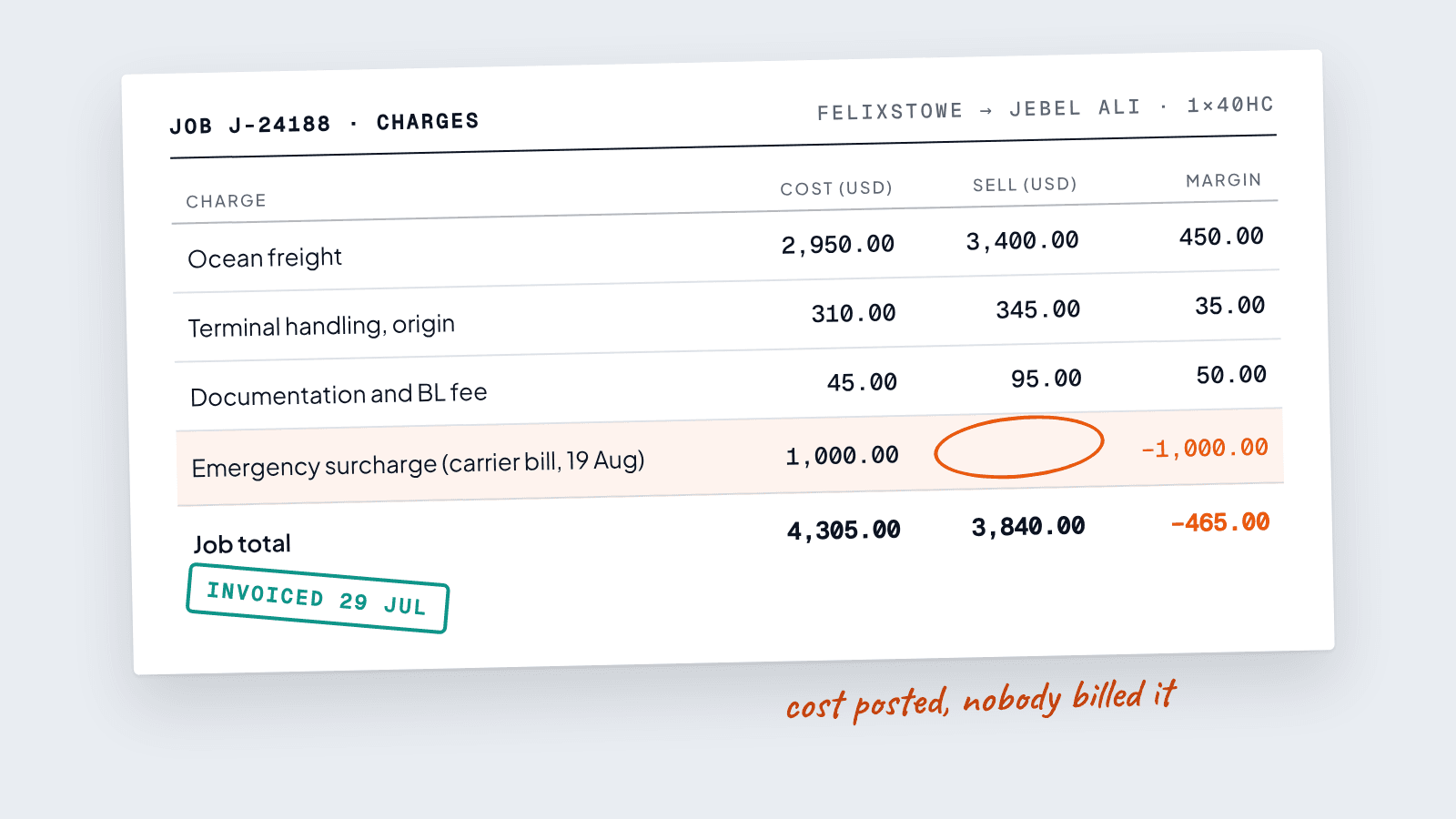
The amounts aren't small. On a 40-foot box to the Gulf, the two Maersk charges above add up to US$4,000. On a forwarder's margin for a single container, one missed line can turn the job into a loss.
Late invoices make it worse
Missed charges and late invoices usually have the same cause. When a team waits for every vendor bill before invoicing, the invoice goes out weeks after sailing. When it invoices from the quote to get paid sooner, late costs get missed.
Either way, the customer's payment terms only start when the invoice arrives. The UK government says late payments close 38 businesses a day and cost the economy £11 billion a year. Its Commercial Payments Bill, introduced in May, would cap the payment terms large firms can set for small suppliers at 60 days and make 8% interest above base rate mandatory on late payments. Those rules help with customers who pay late. They do nothing for an invoice you haven't sent yet.
Invoice on time and still catch the late costs
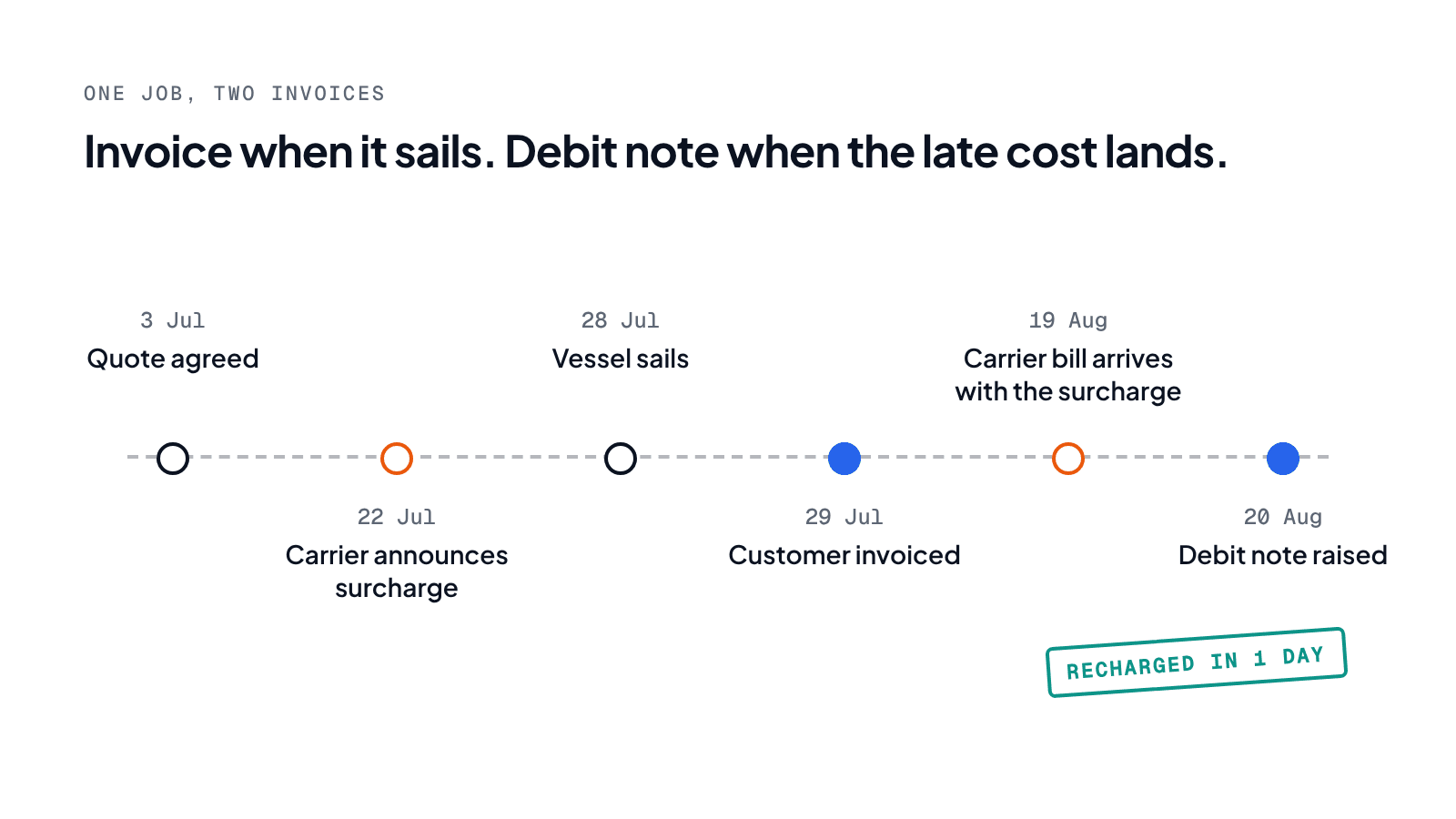
The way out is to stop treating the invoice as a single event. Invoice the job promptly from what you know, then treat every cost that arrives afterwards as a question: does this go to the customer?
That needs three habits:
- Quote terms that allow it. If your quotes say carrier surcharges are passed through as levied at the time of shipment, a supplementary invoice or debit note is routine, not a negotiation. Check your terms with your own adviser.
- Vendor bills matched to jobs the day they arrive. A bill that waits in an inbox for month end can't be recharged until the customer has already paid and moved on.
- A weekly look at costs with no sell line. This is the check that catches what slipped through.
A weekly charges check
Set aside half an hour each week, on the same day. Someone from operations and someone from accounts should do it together.
- List this week's carrier and agent advisories. Note every new or changed surcharge, the trades it covers and when it applies from.
- Find the open jobs it touches. Match by trade, port and sailing or loading date. Mark each one so the charge gets quoted or recharged.
- Match every vendor bill received this week to a job. A bill without a job is the first warning sign.
- Pull every job with a cost line but no matching sell line. For each, decide: recharge, absorb, or dispute with the vendor. Write down the reason if you absorb it.
- Raise the debit notes the same day. A recharge sent within a week of the bill is easier for the customer to accept than one sent a quarter later.
- Look at jobs that sailed more than a week ago with no customer invoice. These are your late invoices.
The first few weeks will turn up a backlog. After that, the check gets shorter, and it's one of the few places in a forwarding business where half an hour reliably finds money.
Where CargoGen fits
In CargoGen, every job has its own charges: what the customer pays, what each vendor is paid, and the margin between them, in multi-currency where needed. Vendor bills are recorded against the job. Its customized AI models read the lines off the bill's PDF and suggest charges for the job, and a person checks them before they're saved.
Because both sides sit on the same job, a late surcharge shows up as a drop in that job's margin, and the shipment P&L report lists receivable against payable across all your jobs. The weekly check starts from that report, and the recharge goes out as a debit note on the right job. More on the Finance module page.
See a job's charges, from vendor bill to debit note.
Bring a recent job with a late surcharge to a demo and we'll show how it would be caught and recharged.



Want to see the platform?
Field notes are nice, but live software is better. Book a demo and we'll run one of your own shipments through it.
Book a demo→